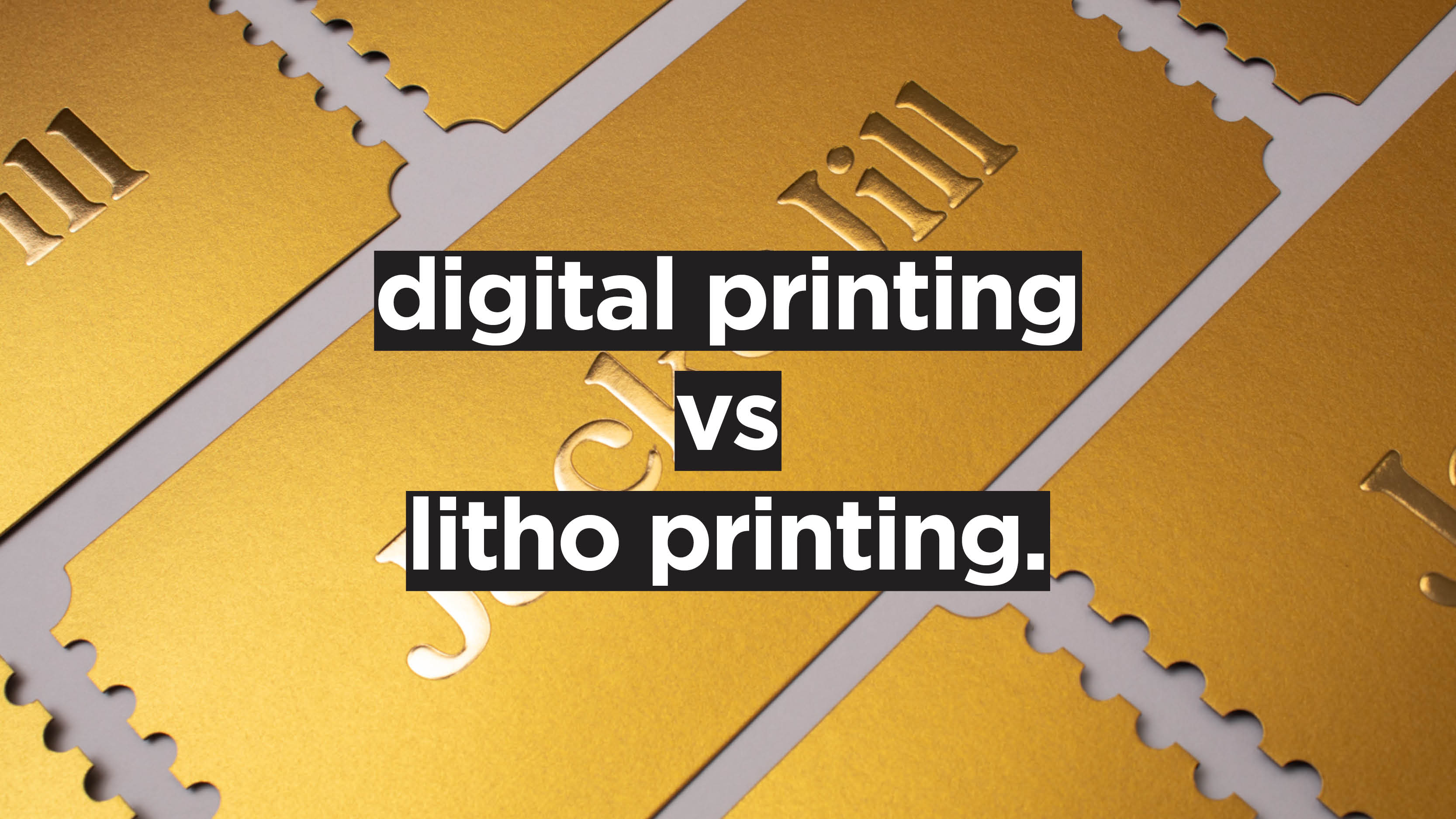
As a dedicated eco-friendly printer, it's vital for us to consider how our printing choices affect the environment. Both digital and litho printing have unique advantages and drawbacks when it comes to sustainability — understanding these differences is crucial to helping our clients make the best decisions.
Their sustainability depends on the size of the print run, the materials chosen, and whether personalisation is needed. Let's look at the differences between these methods and when to choose each.
What Is Digital Printing?
Digital printing is a modern printing technique that uses toner or inkjet technology to produce high-quality prints directly from digital files. It eliminates the need for the traditional printing plates used in litho printing, resulting in less waste and a lower carbon footprint. Generally speaking, digital print is recommended over litho for runs of up to 500 copies.
Digital printing's main assets are print-on-demand (POD) and customisation.
POD, as opposed to batch printing (where items are printed in batches of a few thousand), allows customers to print as many or as few items as needed. This is because the item (be it a book, a flyer, or a magazine) is set up as a digital file that can be processed at any given time, without the need to produce printing plates.
Customisation is easily achieved for the same reason: without the need for plates, it's easy to create multiple versions of the same file to vary the content of each item in a production.
Environmental Benefits of Digital Printing
Waste Reduction
With digital printing, waste is reduced on many fronts:
- No printing plates to be produced and then discarded.
- While lithography requires printing at least a couple hundred "test" sheets to calibrate the colours, digital requires only 1-4, massively reducing paper wastage.
- POD also reduces paper waste by eliminating excessive stock.
Solvents and Inks
Solvent use for digital printing is practically negligible, and the water-based inks used are also safer for the environment.
Energy Consumption
For shorter runs, digital printers consume less energy compared to litho printing equipment.
What is Litho Printing?
Also known as offset printing, litho printing is a traditional printing method that uses printing plates to transfer ink onto paper. It's still the go-to for long-run, high-quality jobs thanks to its unparalleled image quality.
Ideal for runs of over 1,000 copies, litho printing can handle a wide range of paper weights (usually between 70-500gsm) and larger sheet sizes than digital printing.
Litho printing also offers Pantone inks in addition to the standard CMYK ones (providing a better colour match for oranges, purples, and greens), as well as metallic and fluorescent special effects.
Environmental Benefits of Litho Printing
In the past, offset printing often generated significant waste, including chemicals used for making custom presses, water used during printing, and the environmental and health concerns linked to petroleum-based inks and solvents.
But times have changed, and litho printing has made strides toward greater sustainability by adopting greener practices.
Recyclable Materials
Sustainably minded printers like Jump make sure the byproducts of the lithographic printing process are properly recycled. Nowadays, printing plates are made of recycled aluminium, and the test sheets are recycled too.
Solvents and Inks
The petroleum-based inks that litho printing is infamous for became popular over 50 years ago, and (luckily) are barely used today. These inks and solvents produce high amounts of VOCs (Volatile Organic Compounds) that are dangerous to both our health and the health of the planet.
Today, VOC-free inks are much more common. Water-, vegetable-, and algae-based inks are the norm, and so are UV-curable inks that eliminate the need for solvents.
The Verdict: Which Is More Sustainable?
So, is digital printing more sustainable than offset?
Well... it depends.
Digital printing is a great option: it produces very little waste, uses minimal solvents, and relies on water-based inks. But — even though it's traditionally been less eco-friendly, litho printing has also made significant progress by adopting greener practices, using recycled materials and vegetable-based inks.
Thanks to its on-demand capabilities and computerised platform, digital printing can appear more effective in reducing waste. However, we shouldn't overlook its energy consumption. Lithographic printing, even though it may generate more waste during setup and use more energy, can be more environmentally friendly in the long run because, at larger volumes, the environmental impact per print decreases significantly, offsetting the initial costs.
Digital printing is great for shorter runs and on-demand or customisable projects, making it quick and convenient. On the other hand, litho printing shines for larger print runs and top-notch quality.
Both methods come with their own environmental benefits, so the best choice really depends on your specific printing needs!
At Jump, we're passionate about providing sustainable printing options that not only fulfil our clients' needs — but also help protect our planet. We’re proud to use both digital and litho techniques to ensure you get beautiful, high-quality prints that are also eco-friendly. No matter what project you have in mind, our expert team will guide you towards the most effective and sustaiinable printing process.